The Observer Loop from a Psychological Perspective
The concept of an “observer loop” is a powerful metaphor for the feedback cycle between what you perceive and the reality you experience. While a previous analysis deconstructed the pseudoscientific claims of quantum mysticism, a far more effective and scientifically grounded “observer loop” exists within the human mind. This document explores how self-awareness, cognitive therapy, and mindfulness form a powerful, evidence-based system for personal transformation. The true “observer” is not a mystical quantum force but your own conscious awareness.
The Observer Loop from a Psychological Perspective
From a psychological and neurological standpoint, the “observer loop” is the continuous, interconnected feedback cycle of thoughts, emotions, and behaviors. Unlike the mystical view, this loop is not about altering physical reality on a quantum level. Instead, it is about your mind’s ability to observe its own internal processes and, through that observation, consciously reshape its own reality. This loop is the foundation of cognitive flexibility and emotional regulation.
Self-awareness, the cornerstone of this process, is a cognitive function that involves the ability to perceive and understand your own personality, actions, and emotions. Research shows that this process is neurologically linked to the anterior cingulate cortex, a region in the frontal lobe of the brain that plays a key role in attention and self-monitoring. The more you practice observing your internal states, the stronger this neurological network becomes.
Cognitive Behavioral Therapy (CBT) and the Feedback Loop of Thought
Cognitive Behavioral Therapy (CBT) provides a structured, evidence-based framework for “breaking” the negative feedback loops that cause distress. This approach operates on the principle that your thoughts, feelings, and behaviors are inextricably linked in a cyclical pattern. Changing one element can change the entire loop. CBT provides the tools to become an active manager of this loop, rather than a passive participant.
The process involves three core steps:
- Identifying Negative Thoughts: The first step is to become the objective observer of your mind. This involves recognizing the specific thoughts that precede negative emotions or unhelpful behaviors. The goal is to identify these thoughts as they arise, asking questions like, “What thought just ran through my mind?” or “What am I telling myself about this situation?”
- Challenging the Validity: Once a thought is identified, you learn to challenge its validity and accuracy. This involves looking for evidence for and against the thought. This process exposes cognitive distortions, such as all-or-nothing thinking or catastrophizing, that often drive the negative loop.
- Reframing the Narrative: The final step is to reframe the thought into a more balanced and realistic perspective. This isn’t about forced positivity but about creating a more accurate and helpful narrative. For example, instead of “I’m a failure,” a reframed thought might be, “I am a person who faced a challenge and can learn from this experience.” This act of cognitive restructuring effectively alters your internal reality.
The Brain’s Role in Attention and Mindfulness
The brain’s ability to shift its attention is crucial to managing the psychological “observer loop.” In a state of mind-wandering or rumination, the Default Mode Network (DMN) is highly active. The DMN is responsible for self-referential thought and can lead to unhelpful loops of worry and past regrets.
Mindfulness is a powerful practice that trains the brain’s attentional systems. It strengthens the Frontoparietal Control Network (FPCN), which acts as the brain’s executive control system. As you practice mindfulness, the FPCN becomes more effective at overriding the DMN’s automatic thought patterns. This allows you to consciously redirect your attention away from negative rumination and back to the present moment.
Mindfulness Practices: A Guide with Statistics
Mindfulness is a form of meditation that focuses on bringing your attention to the present moment without judgment. It is not about emptying your mind but about observing its contents and gently redirecting your focus. The science behind it is compelling:
- Brain Plasticity: Studies have shown that just 8 weeks of regular mindfulness practice can lead to measurable changes in brain structure, including increased gray matter in the hippocampus (involved in memory and learning) and decreased gray matter in the amygdala (involved in fear and stress).
- Stress Reduction: Mindfulness-Based Stress Reduction (MBSR) programs have been shown to reduce symptoms of anxiety by up to 58% and depression by up to 57%.
- Improved Attention: Even a brief 10-minute daily meditation can significantly improve focus and working memory.
Here is a simple, guided practice:
- Find a quiet place: Sit or lie down comfortably.
- Focus on your breath: Bring your attention to the sensation of your breath. Notice the rise and fall of your chest or the air entering and leaving your nostrils.
- Acknowledge wandering thoughts: Your mind will inevitably wander. When it does, simply acknowledge the thought without judgment. Do not get frustrated. Silently say to yourself, “thinking,” and gently return your attention to your breath.
- Practice non-judgment: The goal is not to have a clear mind but to practice observing your thoughts without getting caught up in them. Each time you bring your attention back, you are strengthening your mind’s “observer” muscle.
- Expand awareness: After a few minutes, expand your awareness to include the sounds, sensations, and smells around you. Maintain this gentle, non-judgmental observation.
- End with intention: When you are ready, slowly open your eyes. Take a moment to notice how you feel. Set an intention to carry this sense of awareness with you throughout your day.
Science-Based Affirmations
Instead of affirmations that rely on mystical or unproven concepts, these affirmations are grounded in the scientific understanding of the mind and nervous system. They serve as intentional reminders of the real, verifiable processes you are engaging in.
- “My brain is plastic and can be rewired. Every day, my new thoughts are strengthening my new neural pathways.”
- “I am the observer of my thoughts, not their prisoner. I can choose where to place my attention.”
- “My breath is an anchor. I can use it to ground myself and bring my nervous system back to calm.”
- “My mind can create loops, and it can also break them. I am in charge of this process.”
- “With every focused breath, I am building the parts of my brain that control focus and peace.”
- “I choose to respond to my thoughts and feelings with curiosity, not with judgment.”
- “My awareness is my most powerful tool for shaping my reality.”
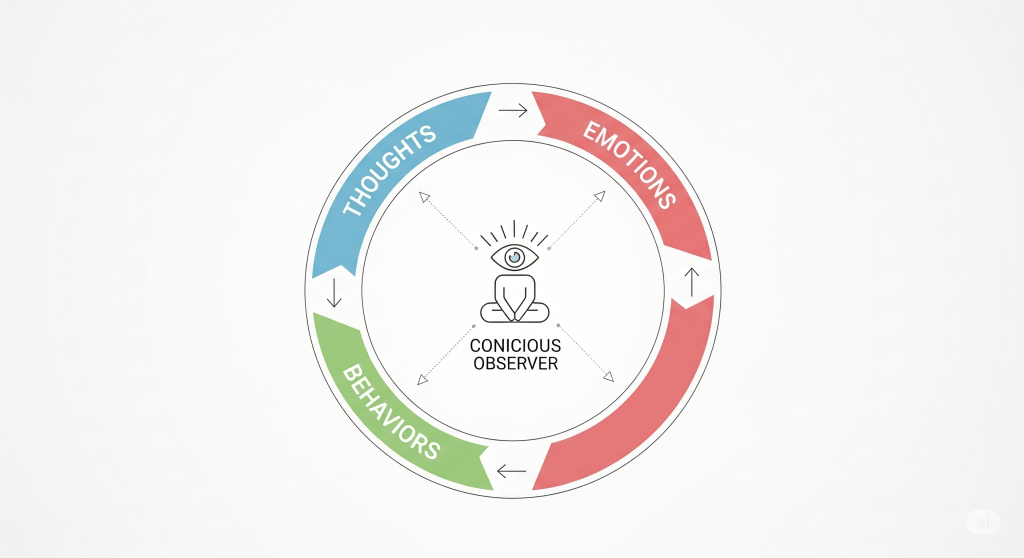
This image represents the psychological “observer loop,” showing how thoughts, emotions, and behaviors are interconnected, with a conscious observer at the center.
While many psychological models focus on the interplay of these three core components, the empty space can be interpreted in several ways, each related to a deeper understanding of the loop:
- The Unconscious: This space can symbolize the unconscious mind—the beliefs, memories, and drives that influence your thoughts, emotions, and behaviors without your conscious awareness. The goal of self-awareness practices is to bring more of this unconscious material into the light of the conscious “observer.”
- The Physical Self: The empty quadrant can also represent your physical or physiological state. Your body’s sensations, stress levels, and nervous system directly impact your thoughts, emotions, and behaviors. This acknowledges the holistic connection between your mind and body, a concept integral to your journey.
- The External Environment: The missing piece could be the external world—the events, people, and situations you encounter. This element is crucial because it often triggers the thoughts and emotions that initiate the loop. Acknowledging its role is vital for understanding your full “reality.”
The empty space is an invitation to consider these deeper, often unseen, forces that influence the loop. It highlights that the process of self-awareness is not just about what you can see but also about what you can learn to see.
Disclaimer
The information presented in this guide is for informational and educational purposes only. It is not intended to be a substitute for professional medical advice, diagnosis, or treatment. Always seek the advice of your physician or another qualified health provider with any questions you may have regarding a medical condition or before starting any new diet, supplement, or fitness regimen.
The statements and information provided herein have not been evaluated by the Food and Drug Administration. The products and practices mentioned are not intended to diagnose, treat, cure, or prevent any disease.
Reliance on any information provided in this guide is solely at your own risk.
 Carmen
Leave a comment