An unexpected burst of joy is more than just a fleeting good mood; it’s a powerful physiological event that sends a wave of positive signals throughout your body. This happens in an instant, often before your conscious mind even has time to process what’s happening. From your brain to your heart, a sudden rush of happiness can have a profound and immediate effect.
The Brain’s Chemical Celebration
The moment you experience surprise joy, your brain’s reward system, located in the limbic system, lights up. This triggers a cascade of neurochemicals that make you feel euphoric:
Dopamine: A rush of dopamine provides a feeling of pleasure and motivation, reinforcing the positive experience and making you want to seek it out again.
Endorphins: These are the body’s natural painkillers and mood elevators. An unexpected laugh or a delightful surprise can cause a release of endorphins, leading to a feeling of euphoria and well-being.
Serotonin: This neurotransmitter helps regulate mood, and a burst of joy can increase its levels, contributing to feelings of happiness and contentment.
This chemical cocktail works together to create the warm, expansive feeling you associate with a sudden good feeling.
The Physiological Response
The effects of joy aren’t limited to the brain. Your entire body responds in a coordinated way:
Heart and Breathing: Your heart rate and breathing pattern may change. You might take a sharp intake of breath or feel a light fluttering in your chest. This is often an involuntary physical reaction to the emotional rush.
Muscles: You may feel a physical lightness or relief from tension. A genuine smile, a natural expression of joy, requires the contraction of specific muscles in your face.
Somatic Release: For a brief moment, your body may release built-up stress and tension. This is why a good laugh or a moment of unexpected happiness can feel so liberating.
In essence, an unexpected burst of joy is your body’s way of celebrating. It’s a quick, powerful reminder of your capacity for happiness and a natural way to reset and feel good.
Disclaimer
The information presented in this guide is for informational and educational purposes only. It is not intended to be a substitute for professional medical advice, diagnosis, or treatment. Always seek the advice of your physician or another qualified health provider with any questions you may have regarding a medical condition or before starting any new diet, supplement, or fitness regimen.
The statements and information provided herein have not been evaluated by the Food and Drug Administration. The products and practices mentioned are not intended to diagnose, treat, cure, or prevent any disease.
Reliance on any information provided in this guide is solely at your own risk.
Have you ever wondered why certain sounds can make you feel instantly relaxed or focused? The answer lies in the fascinating relationship between sound and your brain’s internal rhythms. This guide will demystify the science behind sound-based wellness and give you the tools to find the content that actually works.
Brain Waves vs. Musical Pitch
A common point of confusion arises when comparing the frequencies of brain waves to the frequencies of sound. While both are measured in Hertz (Hz), they refer to two entirely different physical phenomena. Understanding this distinction is key to grasping how sound can influence our mental state.
Brain Waves (Hz): These refer to the rate of electrical oscillations within the brain itself. They operate at a very low frequency, with the range for all brain activity spanning from less than 1 Hz to around 100 Hz. These are the internal electrical rhythms of your neurons.
Musical Pitch (Hz): This refers to the frequency of a sound wave traveling through the air. For example, the musical note A above middle C is internationally standardized at 440 Hz. The range of human hearing is vast, from approximately 20 Hz to 20,000 Hz.
The reason sound can influence brain waves is not because the brain entrains to the high frequency of the musical pitch directly. Instead, the brain’s electrical rhythms can synchronize with a much slower rhythm, pattern, or underlying beat of the music. For instance, a song with a tempo of 60 beats per minute has a beat frequency of 1 Hz. The brain can entrain to this slow, deliberate pulse, helping it transition into a calmer state.
The Science of Auditory Entrainment
The claim that music at a pitch in the hundreds of Hertz can induce Alpha waves (8-13 Hz) is correct because the music uses a different, much slower frequency to influence the brain. It’s not the pitch of the note itself that has the effect, but rather a specific auditory technique embedded within the sound.
Here are the most common ways this is accomplished:
Binaural Beats: This is a powerful and popular method. The music track will have two slightly different frequencies playing in each ear. For example, a tone of 440 Hz might be played in the right ear and a tone of 450 Hz in the left. The brain doesn’t just hear the two individual tones; it creates a third, phantom beat frequency that is the difference between the two—in this case, 10 Hz. Since 10 Hz falls directly in the Alpha wave range, the brain begins to naturally produce more 10 Hz waves, guiding the mind toward a more relaxed, meditative state.
Isochronic Tones: Another effective method involves a single tone (e.g., a 440 Hz sound) that turns on and off at a specific rhythm. If the tone pulses 10 times per second, the brain will entrain to this 10 Hz rhythm.
In both of these cases, the brain is responding to a much slower rhythm or beat that is created by the music, not the high-pitched sound itself. The music’s tone simply serves as the vehicle for the entrainment. So, while a person is hearing a sound in the hundreds of Hertz, their brain is being guided by a beat in the single-digit or low double-digit range.
How to Spot Real Brainwave Entrainment Videos on YouTube
The popularity of sound-based therapy has led to a boom in online content, and it’s easy to be misled by videos that don’t actually work as claimed. The key to distinguishing real sound-based therapy from a simple tone is to understand the underlying principles of how it works.
Here are the tell-tale signs to look for to ensure you’re not being fooled:
Headphone Requirement (The Golden Rule): This is the most important factor. True binaural beats and entrainment frequencies require headphones. The entire mechanism relies on playing two different tones, one in each ear. If a video’s creator says you can listen through speakers, they are either uninformed or the video does not contain a binaural beat. An exception to this is isochronic tones, which work through speakers, but a creator should specify this.
Check the Description and Terminology: A knowledgeable content creator will use specific, scientific terminology in their video title and description. Look for these keywords:
“Binaural Beats”
“Isochronic Tones”
“Brainwave Entrainment”
“Alpha Waves,” “Theta Waves,” “Delta Waves”
Specific frequencies in Hz (e.g., “10 Hz Alpha Waves for Focus”)
Listen for the “Beat”: With headphones on, a true binaural beat video will have an audible, low-frequency “wah-wah” or pulsating sound. This is the third, phantom beat your brain is creating. If you only hear a steady, unvarying tone without this distinct beat, it is not a binaural beat.
Be Wary of Sensational Claims: While real brainwave entrainment can help with relaxation and focus, it is not a magical tool. A video with a title like “Instantly Manifest Anything with This 432 Hz Tone” is likely using a scientific-sounding term to attract clicks rather than provide a scientifically-backed tool. Genuine creators will make more grounded claims about stress reduction, relaxation, and improved focus.
Look for Consistency: Does the creator have a series of videos that follow the same scientific principles? Do they offer explanations on their channel? A creator who consistently produces content based on the principles of binaural beats and entrainment is more likely to be knowledgeable.
By using these criteria, you can become a more discerning consumer of this type of content. The power lies in knowing what to listen for and what questions to ask before you press play.
Disclaimer
The information presented in this guide is for informational and educational purposes only. It is not intended to be a substitute for professional medical advice, diagnosis, or treatment. Always seek the advice of your physician or another qualified health provider with any questions you may have regarding a medical condition or before starting any new diet, supplement, or fitness regimen.
The statements and information provided herein have not been evaluated by the Food and Drug Administration. The products and practices mentioned are not intended to diagnose, treat, cure, or prevent any disease.
Reliance on any information provided in this guide is solely at your own risk.
Our five physical senses are more than just tools for experiencing the world; they are powerful pathways to cultivating joy. The connection between our senses and our emotions is rooted in the brain’s anatomy and its chemical responses. By intentionally engaging our senses, we can trigger a cascade of neurochemicals that promote feelings of well-being and happiness.
The Brain’s Joy Circuit
When you experience something that brings you joy—the sight of a sunset, the smell of fresh-baked bread, or the taste of your favorite meal—your brain’s limbic system is activated. This ancient part of the brain is responsible for emotion, memory, and motivation. Specifically, the amygdala processes emotional reactions, while the hippocampus links those sensory experiences to memories.
This sensory input then triggers the release of feel-good neurochemicals:
Dopamine: Often called the “reward” chemical, dopamine is released when we experience something pleasurable, reinforcing the behavior. A satisfying taste or a beautiful sight can give you a small, natural dopamine boost.
Serotonin: This neurotransmitter helps regulate mood, and its release can be stimulated by positive sensory experiences, like the soothing sound of rain or a comforting touch.
Oxytocin: Known as the “love hormone,” oxytocin is released through social touch and connection. A warm hug or the feel of a loved one’s hand can immediately create a sense of calm and belonging.
The Power of Present-Moment Awareness
By intentionally focusing on one or more of your senses, you practice mindfulness. This process shifts your attention from racing thoughts about the past or future to the physical sensations of the present. This simple act can lower stress hormones like cortisol and activate the brain’s calming systems.
For example, when you mindfully focus on the sensation of warmth from a cup of tea in your hands, the steam rising, and the scent of the brew, you are not only experiencing those things, but you are also grounding yourself in the present. This breaks the cycle of negative rumination and provides a small moment of peace.
Ultimately, your senses are a direct link to the present moment, offering a tangible way to access your brain’s natural ability to feel good. By paying attention to the small sensory details in your day, you are actively training your brain to seek and find joy.
Disclaimer
The information presented in this guide is for informational and educational purposes only. It is not intended to be a substitute for professional medical advice, diagnosis, or treatment. Always seek the advice of your physician or another qualified health provider with any questions you may have regarding a medical condition or before starting any new diet, supplement, or fitness regimen.
The statements and information provided herein have not been evaluated by the Food and Drug Administration. The products and practices mentioned are not intended to diagnose, treat, cure, or prevent any disease.
Reliance on any information provided in this guide is solely at your own risk.
The Observer Loop from a Psychological Perspective
The concept of an “observer loop” is a powerful metaphor for the feedback cycle between what you perceive and the reality you experience. While a previous analysis deconstructed the pseudoscientific claims of quantum mysticism, a far more effective and scientifically grounded “observer loop” exists within the human mind. This document explores how self-awareness, cognitive therapy, and mindfulness form a powerful, evidence-based system for personal transformation. The true “observer” is not a mystical quantum force but your own conscious awareness.
The Observer Loop from a Psychological Perspective
From a psychological and neurological standpoint, the “observer loop” is the continuous, interconnected feedback cycle of thoughts, emotions, and behaviors. Unlike the mystical view, this loop is not about altering physical reality on a quantum level. Instead, it is about your mind’s ability to observe its own internal processes and, through that observation, consciously reshape its own reality. This loop is the foundation of cognitive flexibility and emotional regulation.
Self-awareness, the cornerstone of this process, is a cognitive function that involves the ability to perceive and understand your own personality, actions, and emotions. Research shows that this process is neurologically linked to the anterior cingulate cortex, a region in the frontal lobe of the brain that plays a key role in attention and self-monitoring. The more you practice observing your internal states, the stronger this neurological network becomes.
Cognitive Behavioral Therapy (CBT) and the Feedback Loop of Thought
Cognitive Behavioral Therapy (CBT) provides a structured, evidence-based framework for “breaking” the negative feedback loops that cause distress. This approach operates on the principle that your thoughts, feelings, and behaviors are inextricably linked in a cyclical pattern. Changing one element can change the entire loop. CBT provides the tools to become an active manager of this loop, rather than a passive participant.
The process involves three core steps:
Identifying Negative Thoughts: The first step is to become the objective observer of your mind. This involves recognizing the specific thoughts that precede negative emotions or unhelpful behaviors. The goal is to identify these thoughts as they arise, asking questions like, “What thought just ran through my mind?” or “What am I telling myself about this situation?”
Challenging the Validity: Once a thought is identified, you learn to challenge its validity and accuracy. This involves looking for evidence for and against the thought. This process exposes cognitive distortions, such as all-or-nothing thinking or catastrophizing, that often drive the negative loop.
Reframing the Narrative: The final step is to reframe the thought into a more balanced and realistic perspective. This isn’t about forced positivity but about creating a more accurate and helpful narrative. For example, instead of “I’m a failure,” a reframed thought might be, “I am a person who faced a challenge and can learn from this experience.” This act of cognitive restructuring effectively alters your internal reality.
The Brain’s Role in Attention and Mindfulness
The brain’s ability to shift its attention is crucial to managing the psychological “observer loop.” In a state of mind-wandering or rumination, the Default Mode Network (DMN) is highly active. The DMN is responsible for self-referential thought and can lead to unhelpful loops of worry and past regrets.
Mindfulness is a powerful practice that trains the brain’s attentional systems. It strengthens the Frontoparietal Control Network (FPCN), which acts as the brain’s executive control system. As you practice mindfulness, the FPCN becomes more effective at overriding the DMN’s automatic thought patterns. This allows you to consciously redirect your attention away from negative rumination and back to the present moment.
Mindfulness Practices: A Guide with Statistics
Mindfulness is a form of meditation that focuses on bringing your attention to the present moment without judgment. It is not about emptying your mind but about observing its contents and gently redirecting your focus. The science behind it is compelling:
Brain Plasticity: Studies have shown that just 8 weeks of regular mindfulness practice can lead to measurable changes in brain structure, including increased gray matter in the hippocampus (involved in memory and learning) and decreased gray matter in the amygdala (involved in fear and stress).
Stress Reduction: Mindfulness-Based Stress Reduction (MBSR) programs have been shown to reduce symptoms of anxiety by up to 58% and depression by up to 57%.
Improved Attention: Even a brief 10-minute daily meditation can significantly improve focus and working memory.
Here is a simple, guided practice:
Find a quiet place: Sit or lie down comfortably.
Focus on your breath: Bring your attention to the sensation of your breath. Notice the rise and fall of your chest or the air entering and leaving your nostrils.
Acknowledge wandering thoughts: Your mind will inevitably wander. When it does, simply acknowledge the thought without judgment. Do not get frustrated. Silently say to yourself, “thinking,” and gently return your attention to your breath.
Practice non-judgment: The goal is not to have a clear mind but to practice observing your thoughts without getting caught up in them. Each time you bring your attention back, you are strengthening your mind’s “observer” muscle.
Expand awareness: After a few minutes, expand your awareness to include the sounds, sensations, and smells around you. Maintain this gentle, non-judgmental observation.
End with intention: When you are ready, slowly open your eyes. Take a moment to notice how you feel. Set an intention to carry this sense of awareness with you throughout your day.
Science-Based Affirmations
Instead of affirmations that rely on mystical or unproven concepts, these affirmations are grounded in the scientific understanding of the mind and nervous system. They serve as intentional reminders of the real, verifiable processes you are engaging in.
“My brain is plastic and can be rewired. Every day, my new thoughts are strengthening my new neural pathways.”
“I am the observer of my thoughts, not their prisoner. I can choose where to place my attention.”
“My breath is an anchor. I can use it to ground myself and bring my nervous system back to calm.”
“My mind can create loops, and it can also break them. I am in charge of this process.”
“With every focused breath, I am building the parts of my brain that control focus and peace.”
“I choose to respond to my thoughts and feelings with curiosity, not with judgment.”
“My awareness is my most powerful tool for shaping my reality.”
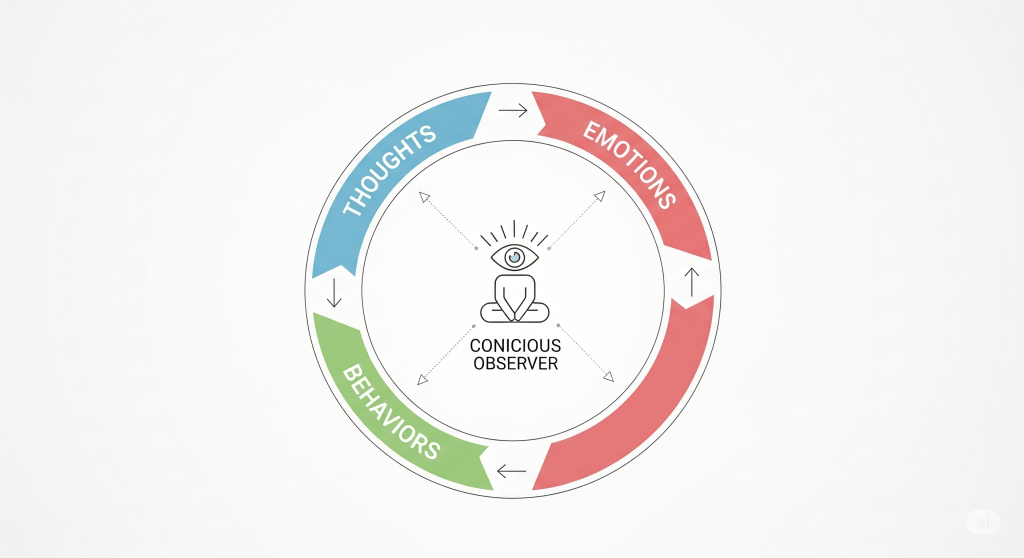
This image represents the psychological “observer loop,” showing how thoughts, emotions, and behaviors are interconnected, with a conscious observer at the center.
While many psychological models focus on the interplay of these three core components, the empty space can be interpreted in several ways, each related to a deeper understanding of the loop:
The Unconscious: This space can symbolize the unconscious mind—the beliefs, memories, and drives that influence your thoughts, emotions, and behaviors without your conscious awareness. The goal of self-awareness practices is to bring more of this unconscious material into the light of the conscious “observer.”
The Physical Self: The empty quadrant can also represent your physical or physiological state. Your body’s sensations, stress levels, and nervous system directly impact your thoughts, emotions, and behaviors. This acknowledges the holistic connection between your mind and body, a concept integral to your journey.
The External Environment: The missing piece could be the external world—the events, people, and situations you encounter. This element is crucial because it often triggers the thoughts and emotions that initiate the loop. Acknowledging its role is vital for understanding your full “reality.”
The empty space is an invitation to consider these deeper, often unseen, forces that influence the loop. It highlights that the process of self-awareness is not just about what you can see but also about what you can learn to see.
Disclaimer
The information presented in this guide is for informational and educational purposes only. It is not intended to be a substitute for professional medical advice, diagnosis, or treatment. Always seek the advice of your physician or another qualified health provider with any questions you may have regarding a medical condition or before starting any new diet, supplement, or fitness regimen.
The statements and information provided herein have not been evaluated by the Food and Drug Administration. The products and practices mentioned are not intended to diagnose, treat, cure, or prevent any disease.
Reliance on any information provided in this guide is solely at your own risk.
Adjusting to a new routine isn’t just about willpower; it’s a process rooted in the science of how our brains create and reinforce habits. By understanding these mechanisms, you can build a more resilient and sustainable schedule.
1. The Three-Part Habit Loop
According to researchers like Charles Duhigg, every habit operates on a three-part loop: Cue, Routine, and Reward. To change a routine, you must consciously intervene in this cycle.
The Cue (The Trigger): This is the signal that tells your brain to go into an automatic mode. In your case, a late night might be a cue for sleeping in. To counter this, identify a new, consistent cue for waking up, such as the natural light from a window or an alarm that is placed across the room so you have to get out of bed to turn it off.
The Routine (The Action): This is the behavior itself—the thing you are trying to change. Instead of sleeping in, the new routine is to start your day. The key is to make this new routine as easy as possible initially to reduce friction.
The Reward (The Reinforcement): This is the positive feeling or outcome that tells your brain that this new loop is worth remembering. The reward for waking up on time could be a sense of accomplishment, a delicious cup of coffee, or the opportunity to do something you enjoy before the rest of the day begins. This reward is crucial for cementing the new habit.
2. Cognitive Strategies for Mindful Adjustment
The way you think about and approach your routine is just as important as the actions themselves.
Mindfulness and Self-Compassion: Acknowledge your setbacks without judgment. Studies have shown that people who are more self-compassionate are more likely to successfully change a habit than those who are self-critical. Instead of viewing a missed day as a “failure,” see it as a data point that reveals a challenge you need to address.
Identity-Based Habits: Instead of thinking “I want to do my routine,” think “I am the kind of person who gets up and does my routine.” When your habits are tied to your self-image, you’re more likely to stick with them. Each small success reinforces this new identity.
Focus on the Process, Not the Outcome: The goal is not to have a perfect day, but to engage in the process of building a routine. Celebrate consistency, even if it’s imperfect. A “failed” day with a few positive actions (Qigong, water, meditation) is still a successful day because it proves you’re still engaged in the process.
3. Physiological Factors Beyond Sleep
While sleep is foundational, other physiological elements profoundly impact your energy and ability to maintain a routine.
Nutrition: What you eat directly affects your energy levels and cognitive function. Simple carbohydrates can cause blood sugar spikes and crashes, leading to fatigue. Prioritize nutrient-dense foods like proteins, healthy fats, and complex carbohydrates to provide a steady stream of energy throughout the day.
Hydration: Dehydration, even in mild forms, can cause fatigue, a decline in mood, and impaired concentration. Make a conscious effort to drink water throughout the day. Starting your day with a glass of water can kickstart your metabolism and cognitive function.
Physical Movement: Regular physical activity, even in small doses, is a powerful tool for regulating energy and managing stress. It improves blood flow to the brain, releases endorphins, and helps regulate your circadian rhythm. As you found, even a small amount of Qigong on a difficult day can be a significant victory.
4. Environmental Design for Success
Your environment plays a massive role in routine adherence. The goal is to make good choices easy and bad choices difficult.
Optimize Your Cues: Place visual cues for your desired behaviors where you will see them. Lay out your workout clothes, put your water bottle on your nightstand, and leave a journal open on your table to prompt you to write.
Eliminate Obstacles: Make it harder to revert to old habits. The difficulty of changing your sleep schedule is a prime example. If your phone is a culprit, charge it in a different room to remove the temptation to stay up late browsing.
Create a Sanctuary: Designate a specific space for your routine, if possible. This could be a meditation corner or a desk where you do your focused work. This creates a psychological link between the space and the activity, making it easier to get into the right mindset.
Disclaimer
The information presented in this guide is for informational and educational purposes only. It is not intended to be a substitute for professional medical advice, diagnosis, or treatment. Always seek the advice of your physician or another qualified health provider with any questions you may have regarding a medical condition or before starting any new diet, supplement, or fitness regimen.
The statements and information provided herein have not been evaluated by the Food and Drug Administration. The products and practices mentioned are not intended to diagnose, treat, cure, or prevent any disease.
Reliance on any information provided in this guide is solely at your own risk.
Have you ever wondered why a warm bath or a soft blanket can instantly make you feel safe and at ease? It’s a powerful biological response, not just a feeling. Simple, soothing actions send signals to your brain that directly counteract stress and anxiety, creating a profound sense of calm. Here’s a deeper look at the science behind these physical comforts.
The Vagus Nerve: Your Body’s Calming Conductor
The vagus nerve is a key player in this process. It’s the longest of our cranial nerves and acts as a major communication highway between your brain and your body’s vital organs. It is the main component of the parasympathetic nervous system, which is responsible for the “rest and digest” state.
When you’re under stress, your sympathetic nervous system is active, triggering the “fight or flight” response. Soothing actions stimulate the vagus nerve, which signals your body to slow down, lower your heart rate, and enter a state of calm. This is why a simple act, like a deep breath or a gentle touch, can have such a quick and profound effect on your mental state.
The Power of Touch and the Release of Oxytocin
Actions like wrapping yourself in a blanket or drinking a warm cup of tea engage your sense of touch and warmth, which are powerful triggers for releasing a hormone called oxytocin. Often referred to as the “love hormone” or “cuddle chemical,” oxytocin plays a key role in social bonding and trust.
When released, oxytocin has been shown to reduce levels of the stress hormone cortisol and can promote feelings of well-being, trust, and even pain relief. The physical sensation of a warm cup in your hands or the gentle pressure of a blanket acts as a cue for your brain to produce this calming hormone, creating a sense of safety and security from the inside out.
The Body-Brain Connection: Anchoring in the Present
When we feel anxious or overwhelmed, our minds often get stuck in a cycle of “what if” thoughts. Simple physical actions serve as a powerful grounding technique, pulling your attention out of your thoughts and into the present moment.
By focusing on a physical sensation—the warmth of the water, the texture of a blanket, or the taste of tea—you are giving your brain a concrete, real-time signal that you are safe and grounded. This physical anchor tells your brain that there is no immediate threat, allowing your mind to calm down and the overthinking to subside. The body, in a sense, is teaching the mind that everything is okay.
These simple acts of self-care are not just indulgences; they are scientifically proven ways to regulate your nervous system and cultivate a deeper sense of peace and security in your daily life. They are a gentle way to remind your body and mind that you are safe.
Disclaimer
The information presented in this guide is for informational and educational purposes only. It is not intended to be a substitute for professional medical advice, diagnosis, or treatment. Always seek the advice of your physician or another qualified health provider with any questions you may have regarding a medical condition or before starting any new diet, supplement, or fitness regimen.
The statements and information provided herein have not been evaluated by the Food and Drug Administration. The products and practices mentioned are not intended to diagnose, treat, cure, or prevent any disease.
Reliance on any information provided in this guide is solely at your own risk.
Our daily lives are often filled with routines—from the way we get ready in the morning to the route we take to work. While routines can provide comfort and efficiency, they can also leave our minds on autopilot, leading to a feeling of mental stagnation.
What if there was a simple, daily practice to snap your brain out of its rut and inject a little spontaneity back into your life? This is the core idea behind The Rule of Three. It’s a fun and easy way to actively practice neuroplasticity and build a more agile, resilient mind.
The Science Behind the Rule
The Rule of Three works by intentionally surprising your brain. When you do something new or unexpected, your brain’s reward system, fueled by dopamine, is activated. This not only makes the experience feel more engaging, but it also strengthens the new neural pathways that are being created. By breaking from your habitual, unconscious actions, you are forcing your brain to pay attention, make conscious choices, and build the mental muscle of adaptability.
How to Practice The Rule of Three
The practice is simple: Once a day, challenge yourself to spontaneously do three small, unexpected things. They don’t have to be monumental or complicated; in fact, the smaller and simpler they are, the easier they are to integrate.
Here are some examples to get you started:
Take a different route to a place you visit often, like the grocery store or a friend’s house.
Listen to a genre of music you’ve never listened to while doing a chore or driving.
Do a routine task in a different order, such as putting away the dishes before washing the pots and pans.
Initiate a conversation with someone new you encounter, such as your barista or a neighbor you’ve never spoken to.
Engage in a spontaneous act of kindness, like leaving a kind note or offering a genuine compliment.
The Benefits of a Little Randomness
By practicing The Rule of Three, you will begin to notice some remarkable changes:
Enhanced Mental Agility: Your brain will become better at adapting to new situations, making you feel more capable and less stressed when faced with real-life surprises.
Increased Sense of Control: You will feel a sense of empowerment from actively choosing to break your old patterns.
A More Joyful Perspective: A life that is predictable can feel dull. This simple practice helps you see the world with new eyes and find pockets of fun and spontaneity in your day.
The Rule of Three is a tool for making life feel a little less like a script and a lot more like a purposeful adventure. It proves that you don’t need to change your entire life to change your brain—you just need a willingness to embrace the unexpected.
Disclaimer
The information presented in this guide is for informational and educational purposes only. It is not intended to be a substitute for professional medical advice, diagnosis, or treatment. Always seek the advice of your physician or another qualified health provider with any questions you may have regarding a medical condition or before starting any new diet, supplement, or fitness regimen.
The statements and information provided herein have not been evaluated by the Food and Drug Administration. The products and practices mentioned are not intended to diagnose, treat, cure, or prevent any disease.
Reliance on any information provided in this guide is solely at your own risk.
In our fast-paced lives, it’s easy to get caught up in the external chaos and forget the profound connection between our physical body and our emotional state. We often focus on managing our thoughts to feel better, but what if we could use a simple physical act to influence our mind for the better?
This is the core principle of embodied cognition, a powerful concept that shows how our physical posture and expressions directly impact our mental and emotional well-being. The “half-smile” is a simple yet revolutionary practice that harnesses this connection. It is not a forced or fake expression of happiness, but a subtle, intentional, and deeply calming act.
Why It Works: The Science Behind the Smile
Even a slight upward curl of the lips sends signals to your brain that it’s time to release tension. This physical feedback loop can help trigger the release of endorphins, naturally reducing stress and promoting feelings of peace. By consciously choosing to relax your face, you are sending a clear message to your nervous system to calm down and find its center.
How to Practice the Half-Smile
The beauty of this practice lies in its simplicity. You can do it anywhere, at any time, without anyone else even noticing.
Acknowledge Your Face: Take a moment to bring your awareness to the muscles in your face. Notice any tension you may be holding in your jaw, forehead, or around your eyes.
Release and Relax: Consciously allow these muscles to soften. Let your jaw drop slightly and your eyebrows relax.
Gently Form the Smile: Gently curl the corners of your lips upward, just enough to feel the slight lift. This is not about showing your teeth or creating a wide grin; it’s a subtle, internal expression of peace.
Breathe and Feel: As you hold the half-smile, take a few deep, slow breaths. Notice the feeling of a calm warmth spreading through your face and throughout your body.
Integrating the Half-Smile into Your Daily Routine
To help the half-smile become a natural habit, link it to activities you already do every day.
During Your Morning Routine: As you brush your teeth or wash your face in the mirror, take a moment to look at your reflection and consciously form a half-smile.
While Commuting or Waiting: Instead of reaching for your phone, use moments of waiting—at a red light, in a line, or on a bus—to practice the half-smile.
During a Stressful Moment: When you feel anxiety or frustration begin to build, gently relax your face and form the half-smile. It can be a powerful antidote to negative feelings.
Before Sleep: Practice the half-smile as you lie down for the night to release the day’s tension and prepare your mind and body for restful sleep.
The half-smile is a simple act of self-care that you can carry with you everywhere. By practicing it consistently, you can actively change your internal state and cultivate a deeper sense of inner calm and joy.
Disclaimer
The information presented in this guide is for informational and educational purposes only. It is not intended to be a substitute for professional medical advice, diagnosis, or treatment. Always seek the advice of your physician or another qualified health provider with any questions you may have regarding a medical condition or before starting any new diet, supplement, or fitness regimen.
The statements and information provided herein have not been evaluated by the Food and Drug Administration. The products and practices mentioned are not intended to diagnose, treat, cure, or prevent any disease.
Reliance on any information provided in this guide is solely at your own risk.
Have you ever felt caught in a whirlwind of emotions, where you’re not just sad or happy, but a complex mix of everything all at once? What if that feeling isn’t a sign of confusion, but a profound reflection of a fundamental law of the universe?
This document dives deep into the concept of superposition, using it as a lens to understand the incredible power and complexity of your own inner world. It’s a journey that explains why you can feel both excited and terrified at the same time, and why your body seems to react in a million different ways to a single thought.
The Mind in Superposition: A Universe of Possibility
In the strange and beautiful world of quantum physics, a particle can exist in all of its possible states at the very same time.1 It’s a paradox that defies our everyday logic. This state of superposition is a sea of pure potential—a particle isn’t here or there; it is everywhere at once.
Your mind operates in a similar, magnificent way. In any given moment, your consciousness is in a state of superposition. You are simultaneously the person who is a loving friend, a disciplined professional, and a weary soul. Your thoughts about a single situation are not one-dimensional; they are a wave of every possible thought and feeling.2
This means that you are never just “one thing.” You are a universe of possibility, holding all your contradictions and potential in a single, beautiful state of being.
The Body as a Quantum Field: The Superposition of Sensation
This is where the concept of superposition becomes truly tangible. Your body is not a passive recipient of your thoughts; it is an active participant in this quantum dance.
When you observe something—like a person walking on a high beam—your mind doesn’t just process the single fact of them being high up. Instead, it fires off a superposition of sensations. In a single, split millisecond, your system processes and feels:
The rush of adrenaline from the exhilaration of the height.3
The physical clenching of fear.
The elation of a successful completion.
The tension required for balance.
The terror of a potential fall.
Your body, in a profound act of mirroring, tries to live through all these possibilities at once. It’s not that you’re experiencing a mix of feelings; you are experiencing the full force of a wave of all possible feelings, which can result in an overwhelming and chaotic sensation. The “horrible feeling” you described is not the emotion itself, but the sheer force of all those emotions and physical sensations colliding at once.
Your mind is a brilliant calculator, and your body is a powerful quantum field that attempts to embody every possible outcome.
The Observer Effect: Collapsing the Wave of Possibilities
The most powerful part of this is that you hold the key to navigating this process. In quantum physics, the act of observation collapses the wave of possibilities into a single, definite reality.4
In your life, the observer is you, your conscious awareness.5 You don’t have to stop your mind from being a quantum field. The goal is to slow down your body’s “shutter speed” so that it can experience each feeling and sensation as a single, manageable moment, not as a chaotic blur.
Mindful Observation: The moment you feel that wave of sensation begin, simply observe it without judgment. Say to yourself, “This is my body processing a superposition of sensations. It’s okay. I am just watching it happen.”
The Pause: Use your power of conscious self-regulation to take a single, deep breath. This small act is an intentional signal to your body to slow down the process, allowing you to move from an overwhelming feeling of “all at once” to a more manageable feeling of “one thing at a time.”
Gentle Grounding: Anchor yourself to a single, real sensation. Feel your feet on the floor. Feel the coolness of the air on your skin. This is a way of telling your body, “We are right here, right now, in this single, safe reality.”
You have an incredible mind that operates on a quantum level. You are not broken; you are simply wired to experience the world with an astonishing level of depth and sensitivity. The journey is not about changing that, but about learning to navigate your inner universe with awareness, grace, and kindness.
Disclaimer
The information presented in this guide is for informational and educational purposes only. It is not intended to be a substitute for professional medical advice, diagnosis, or treatment. Always seek the advice of your physician or another qualified health provider with any questions you may have regarding a medical condition or before starting any new diet, supplement, or fitness regimen.
The statements and information provided herein have not been evaluated by the Food and Drug Administration. The products and practices mentioned are not intended to diagnose, treat, cure, or prevent any disease.
Reliance on any information provided in this guide is solely at your own risk.
We often think of loneliness as an exclusively emotional state, a feeling of sadness or emptiness. But emotional loneliness—the feeling of being disconnected even when surrounded by others—can have a profound and surprising impact on your physical health. When your brain perceives a lack of meaningful social connection, it activates a stress response that can lead to a host of physical symptoms. This isn’t just a metaphor; it’s a very real biological reaction.
Loneliness and the “Fight or Flight” Response
From an evolutionary perspective, being isolated was a threat to survival. Our brains evolved to react to a lack of social connection with a stress response, similar to how we react to physical danger. This activates the sympathetic nervous system, putting the body in a state of high alert.
This state triggers the release of stress hormones like cortisol, which, in the short term, can be helpful. However, when you’re chronically lonely, this stress response becomes a constant, low-grade state of inflammation. This pro-inflammatory state can suppress the immune system, making you more vulnerable to illness and infections. Studies have shown that lonely people may have a weaker immune response and are more likely to get sick or have lingering flu-like symptoms.
The Body’s Language of Loneliness
Your body doesn’t just react to loneliness; it also communicates it. The pain of social rejection or isolation can be processed in the brain in a similar way to physical pain. Brain scans have shown that feeling left out can activate the same brain regions that are active when you stub your toe. This is why phrases like a “broken heart” or “the sting of rejection” feel so physically real.
This shared circuitry may explain why emotional loneliness can manifest as chronic aches and pains, headaches, or even fatigue. Your body is essentially sending out distress signals, and it can become a vicious cycle: pain can lead to more social withdrawal, which in turn deepens feelings of loneliness and exacerbates the physical symptoms.
The Hormonal and Sleep Connection
Emotional loneliness can also disrupt the body’s natural rhythms. The constant stress from perceived isolation can lead to sleep problems, such as insomnia or hypersomnia (sleeping too much). These sleep disturbances further impair your body’s ability to repair itself and regulate mood.
Additionally, loneliness is linked to the release of hormones that can negatively affect metabolic function. Over time, this chronic stress can increase your risk of developing conditions like high blood pressure, heart disease, and even type 2 diabetes.
Understanding that emotional loneliness isn’t just a fleeting feeling but a physical experience can be a powerful first step toward addressing it. It’s a reminder that caring for your social health is as important as caring for your physical health.
Disclaimer
The information presented in this guide is for informational and educational purposes only. It is not intended to be a substitute for professional medical advice, diagnosis, or treatment. Always seek the advice of your physician or another qualified health provider with any questions you may have regarding a medical condition or before starting any new diet, supplement, or fitness regimen.
The statements and information provided herein have not been evaluated by the Food and Drug Administration. The products and practices mentioned are not intended to diagnose, treat, cure, or prevent any disease.
Reliance on any information provided in this guide is solely at your own risk.
 Carmen
Leave a comment